|
R e s e a r c h
T h e B O A C L a b r a d o r s i g h t i n g of J u n e 2 9, 1 9 5 4

Martin SHOUGH & Wim VAN UTRECHT
Case #18
Lisbon, Portugal - July 30, 1976 This Portuguese pilot sighting is from an article published on pp. 2-4 and 19 of the November 1976 issue of the British Flying Saucer Review (Vol. 22, No. 4). The article is by Omar FOWLER, then Chairman of the Surrey Investigation Group on Aerial Phenomena (SIGAP). FOWLER and his team interviewed the Captain and the first and second officers of one of the airliners (a Trident 2 plane) that was involved in the incident. These are their recorded statements, beginning with Capt. D. W.'s narrative: We were about 40 miles south of Lisbon when Lisbon Control [Air Traffic] called up a 'TriStar' that was above us and said: "We have reports of a UFO. Could you confirm the sighting?". We looked up and there, sure enough at 90°, was this very bright light, the sun had just set, there was no cloud, and we could still see the ground. The crescent moon could be seen, but it was daylight to all intents and purposes at 29,000 feet. [As] we looked up, there was this brilliantly white, incredibly bright object. Relative to us, it was at 90° and looked about 30° in elevation. It was an incredible thing to see just sitting there, so I said [to his crew], I think we will just tell the passengers, so I made a cabin address and said: "If you look on the starboard side, you will see what we believe to be a UFO". Then as we were looking, a long cigar-shaped, or sausage-shaped brown affair appeared below it and to the starboard side of it. It just materialised, just appeared there, and then another one appeared next to it. Certainly, I saw this very bright light which Lisbon had asked me to confirm and the 'TriStar' had already said: "Yes, we have this UFO in sight". I confirmed that [to Control] and I said: "There is no way that this is a star or planet". This is all on tape. We saw the bright one for eight minutes, but [as for] the other two, I think the first one appeared two minutes later and the third one at the same time. It was then that I thought I was looking at something very unreal. I think the bright light was fascinating, but the other things were also extraordinary, and something I cannot possibly explain. It certainly was not natural. If natural is what I have been accustomed to for the past twenty years, then this was not natural and the other members of the crew agreed with me. Apart from ourselves and the 'TriStar', there was also a T.A.P. [Portuguese State Airline] '727'. I had been speaking to the 'TriStar' Captain, and then the T.A.P. pilot started speaking to Lisbon and it was then that they said they were going to "scramble" some fighters. Whether they did so or not I don't know, but they were getting excited about it and completely blocked the "air" [radio band]. This was difficult as we wanted descent clearance. Finally we were able to clear with Faro [airport]. The first officer, C.T., who has been flying for 20 years, including 12 years as a Royal Air Force fighter pilot, recorded his version of the events, and his impressions: The 'Trident 2' aircraft [C-AVFG] flying from London to Faro on Friday July 30, 1976, was in a position 08°30' W., 38° S., just South East of Lisbon at 29,000 ft., heading 195°. The speed was 500 knots, the time 2000 GMT. It was a beautiful clear sky, a newish moon had appeared and the sun was setting. A very bright light appeared, well above the horizon, bearing 30° from our position. The light was really incredibly bright; dazzling and very large indeed. Its shape was very difficult to discern. Rather like an enormous headlamp in the sky. It was not a star, planet or satellite. Whilst watching this light an incredible occurrence was witnessed. At a much lower level, a large rectangular object suddenly materialised. It had the appearance of a thick, foreshortened condensation trail. The periphery was of a vapourish appearance and coloured, probably by the setting sun. The centre was very dark, solid looking, somewhat cigar-like and appeared stationary. Approximately 30 seconds later another of these objects suddenly appeared just behind the first. I watched the objects continuously for some five minutes: they appeared to be stationary although the shape did alter slightly, probably due to our own Southward progress. They were not aircraft condensation trails: vapour was present, but it was all embracing the dark centres. I was under the impression that a third one appeared underneath the second but couldn't swear to it. 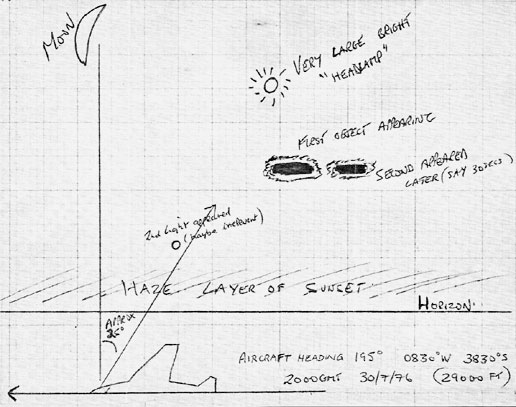
Sketch made by the Captain of the Trident 2 during the course of his sighting. Another light then appeared at "seven o'clock" [relative position] to the headlamp, but was lower on the horizon, not so intense, and maybe unrelated to this situation. The sighting was also observed by a British Airways 'TriStar' en-route to Faro, and by Portuguese Airlines. The Portuguese controller became very excited and talked about sending up fighters to have a look. Whether they did or not I don't know. I have been flying at high altitude now for 20 years, 12 of them in the R.A.F, and have never witnessed the like of this before". The second officer, S. S., who had been flying for five years at the time of the sighting, goes on: The first we saw of the object was when "Air Traffic" called up to the 'TriStar' that was right above us and said that they had a "contact" at about 3 o'clock [area of the sky]`and was there anything there? So we turned around [in our seats] and had a look. There, at 3 o'clock or slightly higher, was this bright light. It was daylight and the sun was setting, and it certainly appeared to have form rather than being a point source. It was far too bright to be a star, or anything explainable, no matter what effects the atmosphere may have had. We watched this thing for a while and then, below it to the right, a fat sausage shape appeared, then behind that another one appeared. I am not sure about those, the thing that was totally unexplained was the light. The sausage shape could at a stretch of the imagination have been contrails caused by an aircraft, but they were too short and besides that they could only have been made by a very large aircraft, or whatever, and in any case the atmosphere was very dry and there were no contrails being produced by any aircraft, so it is very unlikely that it was a contrail. Really that is all there was. This thing, the light, was stationary but I wouldn't like to say what happened to the brown things as they were getting further away all the time behind us. We carried on down over the coast, turned in to descend and could still see the light in the distance. The thing that interested me was the light, for it was totally inexplicable. I have a Physics degree, so I am not completely "lay" about it. Anyway we came back to London Airport and reported it to "Air Traffic" and filled out a report on the UFO forms. The light was of several orders of magnitude brighter than any star. As far as I am concerned it wasn't any star; it was a very bright white light. The crew questioned the passengers at Faro Airport after the landing. Nobody had had a camera available, but one witness had binocular, and had viewed the bright light. He described seeing an object like "crinkled silver paper" in the middle of the light. After the initial contact made on the flight from London to Faro (Portugal) at 2000 GMT on July 30, 1976, the aircraft landed, refuelled and took off for the return flight to London, the crew decided to switch on the radar and scan the area where the initial contact had been made. Comment - The FSR article goes on to describe how, on the return flight, a very large radar blip appeared on the Trident's radar screen (the blip was "elliptical" in shape and at least three times the size of a blip that is normally generated by a big tanker). Smaller blips accompanied the big one and despite their "solid" appearance nothing out of the ordinary was seen visually. Although a connection between these radar anomalies and the sighting that occurred two hours earlier is uncertain, it has been established that the strong temperature inversions that are required for mirages to occur, can generate so-called "radar angels" or false echoes. As for the bright light, we note that, despite the fact that all witnesses are convinced that it was too bright to be a star or a planet, Venus was shining brightly (magnitude -3.77) in the very part of the sky the pilot and co-pilots were looking at. At 20:00 GMT Venus was at an elevation of 7° (calculated for an observer at 8,990 m or 29,000 feet above ground level), and some 35° to the right of the Moon. This is a fairly good match with the angle indicated in the sketch made by Capt. D.W. ("APPROX 25°"). The Moon itself was a crescent shape (phase: 0.17) and positioned 21° above the horizon for an observer at 8,990 m. So if the "VERY LARGE BRIGHT HEADLAMP" in the sketch represents Venus, it was drawn too high. It is not uncommon for witnesses to overestimate the elevation of astronomical objects, but one would expect the captain to have respected the mutual distances (note however that there's at least one error in the sketch: the hornets of the waxing Moon are facing the wrong way; they should be pointing to the left, not to the right). If, on the other hand, the unknown light was something else, one would expect the witnesses to have reported two bright lights in the Western sky: the unknown light AND Venus. However, with the upper part of the solar disc just touching the horizon and the Evening Star only about 11° away from the Sun, it is conceivable that there was too much skylight for Venus to be visible with the naked eye. So this is not conclusive. Two other planets were in the same part of the sky: Mercury and Mars, but there respective magnitudes of -0.73 and 1.75 make them too weak to be visible in a situation where "it was daylight to all intents and purposes". Perhaps a sunlit high-altitude balloon offers a better explanation for this "BRIGHT HEADLAMP". 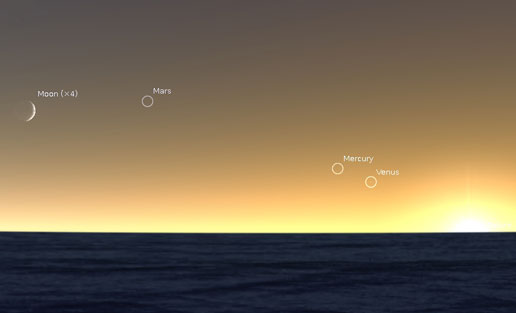
Western sky as viewed from Lisbon, Portugal, on July 30, 1976, at 20:00 UT. Open circles indicate the position of Mars, Mercury and Venus. [Image generated with Stellarium.] It is also not clear what caused the red light "lower on the horizon". Mars was well up in the sky with an elevation of 20°. The brighter Mercury was much closer to the horizon (about 10° elevation) but very close to Venus (about 4° distance), so it's likely that Mercury would have been outshined by the Sun as well. A red warning light marking a high building or a ship's masthead light are improbable because they would have been easily identified in clear weather conditions. Anyway, this smaller light was qualified as "maybe irrelevant" by the captain and "possibly unrelated" by the first officer. Our interest lies with the dark cigar-shaped objects seen closer to the horizon. The sudden "materialisation" and the constant bearing of these shapes are indicative of a mirage. Yet, there are no islands, rock formations or mountains in the direction the dark objects were observed, meaning that only cloud tops could have acted as targets for a mirage. A pair of lenticular orographic clouds is unlikely because the nearest mountains West of the sighting location are on the Azores, more than 1,400 km (870 miles) distant. An alternative explanation for the Trident 2 incident would be a submarine-launched missile (the white light) with a horizontally dispersed backlit contrail (the dark object with the two smaller ones further away). But in that case the (apparent?) immobility and long sighting duration (at least 8 minutes) would make strong counter-arguments.
The authors look forward to receiving additional reports and/or comments which may help assess the soundness of the mirage theory for this particular type of UAP sightings (to contact us, see our e-mail address on the contact page).
|
||