|
V i s i t o r r e s p o n s e s
| Received : 11/20/08 |
Daniel LEVIN |
|
| |
| |
There were lengthy and extensive sightings of vertical light pillars in the Philadelphia, Pennsylvania, USA last night from around 7:30 to 8:30 p.m. local time.
See this link for photos and comments: www.nbcphiladelphia.com.
I saw them myself from my home nearly due east, about 25 miles from Philadelphia, which is the 4th largest city in the USA. People living north, west and even south of Philadelphia reported seeing them, as did some other scattered around. You can check the reports yourself.
I found your web site on this phenomenon and posted it on the comments section of the news report above. But I don't think that has garnered much attention and there is still a lot of random speculation. This TV station's weatherman, who didn't see the lights himself, reported that the event was probably "virga" (which I had never heard of), which he described as snowfall refracted by moonlight. I don't think so, given the nature of the phenomenon.
The weather conditions were nearly perfect for the "vertical light pillars in cirriform clouds" explanation. Ground temp was about zero degrees Celsius (32° Fahrenheit) and there were mostly clear skies during the event with snow moving in from the northwest. There was almost no wind, and the area is relatively flat with no mountains. The topography does include some ridges but no mountain peaks. Sunset was at about 5:15 p.m. local time, and I don't believe moonrise was for several more hours, so we can be quite confident that these were not some other kind of light pillars.
There were several VERY bright and stable light pillars and dozens of other fainter light pillars. As in other cases you cite, there are refineries with open-flame burn-off much of the time in the area.
The phrase "vertical light pillars in cirriform clouds" hardly inspires much enthusiasm among people for this unusual phenomenon since it sounds so strange and scientific. May I suggest that you assign a more colloquial name, which I will borrow from one of the other comments I read: "Angels Wings".
I look forward to your response, and I suggest that you contact Glenn "Hurricane" SCHWARTZ at NBC Channel 10 in Philadelphia so he can correct his earlier speculation.
Dan LEVIN
Garnet Valley, Pennsylvania
Our reply :
We are very grateful to Dan Levin for sharing with us his personal sighting of what appears to have been an exceptional spectacle (for more details about the November 19 sightings, see the next entry on this page and the two photos of the lights which we included in our picture galleries).
With regard to the origin of the phenomenon, there can be no doubt: these "vertical light pillars" were unmistakably the mirrored images of ground-based lights reflecting in transparent layers of ice crystals. Immediately after receipt of Mr. LEVIN's mail, we posted this explanation on the NBC Philadelphia Weather Stories forum. Together with several earlier posts with links to our web site, notably by Mr. LEVIN, this seemed to help in putting an end to the random speculation.
In the November 19 display, meteorological conditions were apparently favourable enough for almost every unshielded light to be mirrored in the sky. The quantity and quality of the reflections indicate that the ice-crystal cloud must have been relatively close to the ground (though not close enough to be qualified as "ice mist" because, in that case, the lower part of the pillars would have connected with their light sources). Soundings from a weather balloon released from Pittsburgh on November 20, at 00:00 Zulu Time (i.e. about half an hour before Mr. LEVIN spotted the light pillars) suggest an ice-crystal layer at 2.4 km (1.5 miles). Usually, these cloud layers form at altitudes higher than 3.5 km (2.2 miles), but from time to time they are known to form at lower altitudes as well, especially in northern regions such as Alaska and Finland.
As for assigning a more colloquial name to the pillars, we refer to the final paragraphs of Chapter 2 of our research article on lights pillars in cirriform clouds. At the end of the 19th, beginning of the 20th century, the name "gas comets" was often used to designate the pillars. For several years, we ourselves referred to the lights as "gas flame reflections", but we stopped using that name when we discovered that poorly shielded spotlights can cause them as well. A less technical term would indeed be desirable, but personally we don't think the name "Angel Wings" matches very well the characteristic needle or pencil shape of the reflections.
The pillars seen over Philadelphia are also the subject of one of our case examples.
CLOSE |
|
| |
| Received : 11/20/08 |
Anthony VELGUS |
|
| |
| |
Hello, I just wanted to report seeing some light pillars last night near White Haven, Pennsylvania at approximately 00:30 Zulu Time. I thought what I was seeing could have been the aurora but one particular bright pillar looked like a laser beam shining up through the clouds with several fainter ones in a different direction. It was a dark, cold night and some parts of the sky were clear w/ some visible scattered clouds. I did not get any photographs because my camera is not capable of taking pictures in the dark or slow shutter speeds.
Anthony VELGUS
White Haven, Pennsylvania
Our reply :
We replied to Mr. VELGUS in very much the same way as we replied to Mr. LEVIN's e-mail of the same date. The fact that nearly all witnesses described the pillars as stationary and appearing either in the east and southeast (according to reports received by witnesses living west and northwest of Philadelphia) or in the west and south (according to reports from witnesses living east and north of the city), is a clear indication that the lights were not auroral pillars.
The pillars seen over Philadelphia are also the subject of one of our case examples.
CLOSE |
|
| |
| Received : 11/21/08 |
Anthony VELGUS |
|
| |
| |
Thanks for the explanation, but now I have another question : does the light source necessarily have to be shining directly up to cause this phenomenon or can the light be at various angles and still cause the pillar to be 90 degrees to the horizon? I do not think there are many lights in this area that send light up as most I ever see are shining down and are mostly shielded.
Anthony VELGUS
White Haven, Pennsylvania
Our reply :
The light sources that cause the vertical pillars do not have to be shining directly up. What counts is that their emitted light reaches the upper and lower surfaces of the transparent ice-crystal plates. Since these crystals are wobbling in a more or less horizontal position somewhere halfway between the light source and the observer, the angle of incidence (and therefore also the exit angle) can be quite small, especially when we are dealing with very distant light sources (see also our simplified diagram). Bright spotlights illuminating buildings and monuments, and even floodlights shining down over playgrounds or football fields can direct enough light to the sky for it to reflect of distant ice-crystal plates. In the latter case, the resulting reflections will have the shape of a series of whitish, parallel streaks close together. The number of streaks depending on the number of spotlights surrounding the field and their position relative to the observer.
Because the distance between the light source and the observer is often in the order of several miles (up to 50 km/31 miles and more!), there usually are no direct visual clues as to which lights are causing the reflections (most of the light sources will be behind the horizon or hidden from view by houses and trees).
The pillars seen over Philadelphia are also the subject of one of our case examples.
CLOSE |
|
| |
| Received : 11/21/08 |
Daniel LEVIN |
|
| |
| |
Thanks for the reply and the additional confirmation that is was a light pillar event. The only reason I can think of that even meteorologists would not know about this phenomenon is that it is so rare, particularly to the extent that it was visible on Nov. 19 in a several thousand square km area.
You know much more about weather and atmospheric conditions than I do, but I can assure you that without an easily-remembered name for such an event the public will forever be flummoxed whenever it occurs. But, if it was called something like "Angel Wings", people will remember it and when it occurs there will be much less speculation. And I submit that such a name is close enough to there appearance - since many of the vertical pillars were close together and ephemeral - to stand in for the actual image. (After all, who really knows what angel wings look like?)
This was not my idea or name, but I know a good slogan when I hear it. TV weathermen are also more likely to reference a positive image name that their audience can relate to. This name would leverage your diligent scientific efforts to explain this wonderful phenomenon, as the general public could search on that term and dispel the mystery, but maintain the wonder.
Dan LEVIN
Garnet Valley, Pennsylvania
Our reply :
While it is true that light pillars in high-altitude clouds are not a common thing, they are not really that rare either. We ourselves have managed to photograph them on five occasions (see for example photos with indications OP-PH-06, 07, 11, 12, 13, 14, 15 and 27 in our picture gallery of artificial light pillars). It does help of course if you know where to look. The glow of a distant gas flame for instance can tell you that, if a reflection occurs, it should have the same azimuth as the flame, while the location of the flame will tell you whether the mirrored image will appear high in the sky (when the flame is only a few miles distant) or low on the horizon (when the flame is several tens of miles away).
Regarding the need for an easily-remembered name, we think Mr. LEVIN's point is well taken. Still, we remain reluctant to use the name "Angle Wings", not only because, in our opinion, "Wings" point to a specific shape which the lights do not have, but also because, normally, only very bright lights generate a reflection, meaning that in most cases only one isolated pillar is seen. For that reason, ascribing a name to the phenomenon that can only be used in a plural form, seems a bit odd.
The pillars seen over Philadelphia are also the subject of one of our case examples.
CLOSE |
|
| |
| Received : 11/24/08 |
Daniel LEVIN |
|
| |
| |
I'm sure that the phenomenon happens more than it is observed here, but to have on occurrence in a place where the meteorologist don't even recognize it and to have dozens of light pillars visible over hundreds of square kilometers and many compass directions has to be rare.
One other point of local geography of which you may not have been aware is that Pittsburgh is over 500 km (300 miles) from Philadelphia, so I don't know if that impacts the conclusions you drew from the balloon sounding you mentioned or not.
Dan LEVIN
Garnet Valley, Pennsylvania
Our reply :
Although the Pittsburgh weather station from where this balloon was released is about 450 km (roughly 280 miles) west of Philadelphia, it was our best option. With winds blowing from a generally western direction, and knowing that the balloon was released at 7 p.m. while most of the sightings occurred between 7:30 and 9 p.m., we can be pretty confident that the data registered by the Pittsburgh balloon matched fairly closely the atmospheric condition for the Philadelphia area. Still, we admit that an altitude of 2.4 km for the ice-crystal cloud is not to be considered an established fact. We are currently trying to collect additional data that may help determine the altitude of the reflective ice-crystal layer more accurately.
The pillars seen over Philadelphia are also the subject of one of our case examples.
CLOSE |
|
| |
| Received : 11/20/09 |
Anthony FAULKNER |
|
| |
| |
On the night of November 18th, 2009 I saw about 20 light pillars in the sky above Mihonoseki, Shimane, Japan. It was very strange, I originally thought it might be Aurora, but researching it proved otherwise. They lasted about 2 hours, unfortunately my camera wouldn't pick them up.
Anthony FAULKNER
Sakaiminato, Japan
Our reply
An Internet search brought to light that there are no petrochemical works or gas wells in the prefecture of Shimane that may have caused these light pillars. A more likely possibility therefore is that the pillars were the reflections of bright lights attached to fishing boats (see Section 4 and in particular the black and white photo taken from Fukui showing a group of light pillars caused by a fleet of fishing boats).
We sent Mr. FAULKNER a map of the sighting location and asked him if it would be possible to indicate the direction in which the lights had appeared and give us an estimate of their elevation angle.
Mr. FAULKNER responded right away. Below is the Google Earth image which he returned to us followed by some explanatory notes:
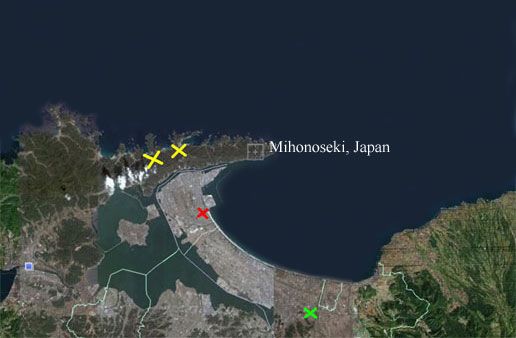
The red X is where I was, the green X is where my friend was and he saw them also. (approx 10 miles away from me) The yellow X's are about where I saw them, about 30 to 40 degree angle. The northern horizon was also pretty bright. In Japan the air gets hazy quite often, not quite cloudy that night but I couldn't see any stars to the north. I could see stars straight up and to the south though. The temperature on the ground was about 5 degrees C.
The black and white picture was almost exactly what I saw, I was thinking it was from fishing boats, since Sakaiminato harbour is the 8th largest fishing port in Japan (I think).
Although I didn't see any pillars close to the horizon, there is a small mountain in the way.
This additional data provided by Mr. FAULKNER pretty much confirms the idea of fishing boats using bright lights to lure squid into their nets.
CLOSE |
|
| |
| Received : 01/28/10 |
Fred ZUMPANO |
|
| |
| |
I live on the outskirts of Akron, Ohio. Tonight, Jan 28, 11 p.m., took my dog out. As I look on the horizon of this busy city (population of the metro area is 750,000), and look towards the city, vertical shafts of light are rising in the southerly sky. The night is clear, full moon above, few clouds on this horizon but some. I often look to the sky and I have never seen anything like this. I am a 53 year old architect, I have never seen the northern lights here, and when I look away from the city I do not see the lights.
I went to the internet to search for an explanation of this phenomenon, but found none. I found your site and thought I would report this unusual occurrence.
There are approximately 20 shafts of light stretching out over 135 degrees of the southern horizon, some more defined than others. Some/most start near the ground but many go 45 degrees up in the sky. The full moon is directly above.
Any clues to what is causing this effect would be appreciated.
Fred ZUMPANO
Akron, Ohio
Our reply
According to www.wkyc.com, that same night, television meteorologists received calls from other residents in Akron wondering about what appeared to be "beams of light shooting upward from a line of spotlights".
In our reply to Mr. ZUMPANO we pointed out that the description of "vertical shafts of light", "starting near the ground", "some more defined than others" is typical of a display of Artificial Light Pillars, i.e. pillar-shaped reflections from bright, ground-based light sources in clouds of ice-crystals.
In medium climates, these pillars usually appear only in high-altitude clouds, but the very cold temperatures that prevailed in Akron on January 28 (- 12.7°C or 9.1°F at 11:00 p.m.) created the proper conditions for water droplets closer to the ground to turn into billions of tiny, highly reflective ice-crystal plates.
We invited Mr. ZUMPANO to take a look at our gallery with pictures of "light pillars in low clouds" (a sub category of our picture gallery on artificial light pillars). On February 3, Mr. ZUMPANO kindly sent us the following reply: "There is no doubt: what I saw is the phenomenon photographed in OP-PL-08. It was a once in my lifetime occurrence and I thank you for explaining it". We, in turn, thank Mr. ZUMPANO for contacting us.
CLOSE |
|
| |
| Received : 09/04/11 |
Andrew T. YOUNG |
|
| |
| |
[This visitor response relates to Chapter 4 of our article on light pillars, and in particular to the part where we mention the observation of a "circular reflection" near the zenith produced by a combustion flame from an oil rig in the North Sea on October 20, 1993.]
I think you'd have a hard time getting a *spherical* reflection.
There must always be some imperfection of alignment of falling ice crystals, not only from the ever-present small-scale turbulence, but even from thermal agitation (Brownian motion). You'd need them to be absolutely horizontal, with average inclination no more than a couple of minutes of arc. You *also* need the layer of ice crystals to be very thin; otherwise, you get the vertically-extended columns of reflections nicely shown in some of your photos.
On the other hand, there are rare reports of such reflections, seen from below a cloud. Often these are described as "mirages", but the details of the accounts clearly indicate a much greater angular extent
than mirages permit; so I assume distinct reflections from falling ice plates do rarely occur. Probably the best-known example is:
The Eiffel tower reflection (cf. Tissandier's 1890 review)
Letter from Charles-Henri Martin to Flammarion, referring to his book "l'Atmosphere". The engraving is evidently from the description, not from observation. Probably not a mirage. In the Feb.,1890, issue.
C.-H.Martin
Mirage de la Tour Eiffel
l'Astronomie 9, 41-42 (1890)
Andrew T. YOUNG
San Diego, California
[Andrew YOUNG is an astronomy professor at San Diego State University and commonly regarded as a leading expert on mirages. Andy's main interest lies with Green Flashes (phenomena visible at sunrise and sunset, in which - at sunset - the upper portion of the Sun's disk suddenly changes from yellow or orange to an astonishing green colour for a second or two). His website, probably the most informative on the subject, is at mintaka.sdsu.edu.]
Our reply
Andy YOUNG is, of course, absolutely right. When we examined the North Sea sightings in 1993/1994 it didn't dawn on us that very exceptional conditions would be required for a specular reflection of a ground-based light source to show up as a round spot near the zenith. In fact, it was only in 2006 that Joël BAVAIS' spectacular photo of a star-shaped reflection made that clear to us.
So in order to explain the October 20, 1993 observations from ships and oil platforms in the North Sea, we would require exceptional conditions (thin layer + crystals perfectly aligned horizontally with average inclination no more than a couple of minutes of arc). Weather data for October 20 only specify a temperature of 9° C, wind from the southeast and 2/8 to 3/8 cloud coverage at the beginning of the sightings with clouds finally obstructing the lights from view. Nothing is said about wind speed, but there's a statement by a passenger from one of the ships informing us that "there was too much movement to take photographs", suggesting that there was at least some wind at the time of the observations.
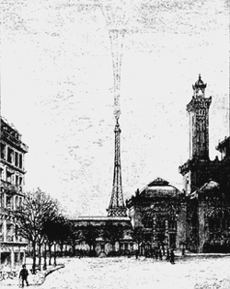
Left is the engraving Andrew YOUNG refers to. Initially published in L'Astronomie 9, 41-42, it depicts a mirrored image of the Eiffel Tower as reportedly observed on December 6, 1889, at 9 a.m. local time.
[Image gleaned from gallica.bnf.fr]
Below is an English translation of the report doctor Charles-Henri MARTIN, a friend of the observers, sent to French astronomer Camille FLAMMARION, publisher of L'Astronomie and prolific author of more than 50 titles.
"Last Friday 6 December, at about 9 o' clock in the morning, City Engineer Lion, Mr. Didier and Mr. Laureau were at the Place du Trocadéro, on the corner of Kléber lane. From this point one can see the top half of the Eiffel Tower, behind the left part of the buildings from the Palais du Trocadéro.
At that time the weather was bright and the sun was shining. All of a sudden, the observers noticed that the tower was surmounted, points touching, by a second, upside-down tower, oriented in the same axis as the real one. This reversed image was very sharp, to such a degree that one could clearly distinguish the peak, the ball at the end, and all the cross-beams from the upper part of the tower; the second platform could also be distinguished; the central part was less clear, and the base had vanished, lost in the haze higher up.
Very close and behind the real Eiffel Tower, over the Champ-de-Mars, one could notice, especially on the right, towards the West, a low cloud, sitting at a level with the middle part of the tower, very bright, shining like silver, of a flake-like appearance. The apparition remained very sharp during the few minutes the observers were on the square. It is said that it was still visible after they had walked past the buildings of the Trocadéro to the fountain. The sun was shining through the haze, to the left of the tower, almost on a level with the second floor."
A very interesting meteorological phenomenon indeed, and we are delighted to bring it to the attention of our readers. The conditions in which it occurred are known. The layer of air immediately on top of the tower served as a mirror. At ground level the temperature was 0°. At the top of the tower it was -3°,5. Wind Northeast and weak.
Another engraving of what appears to have been a similar case of extraordinary aerial reflection was published in FLAMMARION's L'atmosphère et les grands phénomènes de la nature. It shows another part of the French capital mirrored in the sky. This display is said to have occurred some twenty years earlier during the early hours of December 14, 1869, between 3 and 4 a.m.
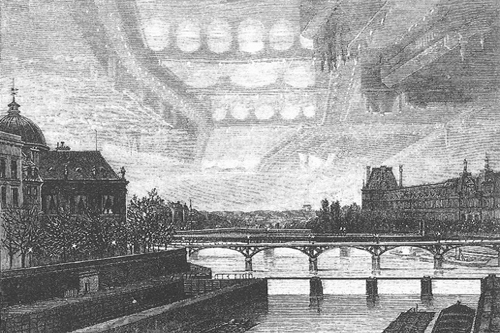
Image scanned from p. 44 of Het Weer (Ed. De Lantaarn, Amsterdam, 1982)]
The text accompanying this engraving reads as follows:
Hardly a season goes by without the papers reporting on a sighting of a superior mirage produced in our moderate regions, like for instance the reflection of a city in the sky; but, in general, the images are transient and diffuse. In 1869 we had one such event in Paris, all the more stranger because it occurred by moonlight. In the night of 14 December 1869, between three and four o' clock in the morning, people returning from the soirée and crossing the bridges and the river banks, were witnesses to this curious phenomenon. The moon was shining beautifully, but the moon and the sky were fogged with clouds that seemed to be lit by the light of the aurora borealis. It was a nice example of a superior mirage, and for more than an hour only a few rare spectators were able to examine this interesting spectacle.
Paris, its palaces, its monuments and the river showed up in the clouds that masked the sky, but the images were reversed, as if someone had placed a giant plate of glass over Paris. Depicted were the Pantheon, Les Invalides, Notre-Dame, the Palais du Louvre and the Tuileries. From the Pont des Arts you could see the Seine, the bridges, the spires of the Saint-Clotilde, the Place de la Concorde, the Champs-Elysées and the Palais de l'Industrie, that, silvered by the moonlight, produced a pink image of an indescribable nature.
The lack of high-quality data and independent eye-witness accounts raises doubts as to the accuracy of these reports. If the phenomenon is real, one would expect someone to have captured it on photo or video in later years. Yet the only photographic evidence of ground-based features mirrorred in ice clouds (not mirages!) are photos of pillar-shaped reflections of bright lights such as can be seen in these two shots:
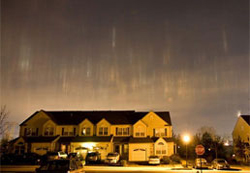
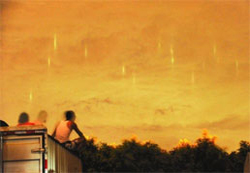
A cloud of ice-crystal plates at 400 m (1,300 ft) reflects the city-lights of Philadelphia. Photo taken by David WEI from Plymouth Meeting on November 19, 2008. See our case analysis for more details.
A similar display photographed at Xiamen, China, on July 9, 2010". [Image borrowed from whatsonxiamen.com].
Leaving aside anecdotal evidence from earlier centuries describing phantom armies and ghost ships in the sky, we found only one "recent" report of a crisp, reversed image of a ground-based feature (in casu a tall building) identical to what is depicted in the engravings published above. Unfortunately, the date is not given, but the story, as told by the observer, has been on the Internet for at least fifteen years. We quote:
One evening my wife and I were returning to work after dinner. (That is what happens when you start your own company!) Off to the right I saw a multi-story building where none existed a couple of hours earlier! I asked my wife, "when did they build that!" to which she responded with a mild profanity. There it was - a tall, well lit building with bricks, windows, and lights along the roof line shining down on the sides. We turned right to investigate this miracle of construction. But, as we approached the structure, it began to move! Soon it literally took off into the air, flying out over highway 183. Keep in mind, this thing was not a blur of lights. It was a flying building. Realizing it was some sort of illusion, we gave chase and ended up heading west ("north") on 183. We pulled into a parking lot when we had a really good view of this hovering building and we jumped out to get a better look. There was no clearly visible bottom and it seemed to be several hundred feet up, but it was quite clear. If there had been a person standing in one of the dark windows we could have easily seen him. Now for the discovery... Directly below the flying building was another building. This structure was identical except that there were no roof lights. There were, however, lights mounted on the ground pointing UP at the sides of the building. We were looking at a high quality reflection office or some sort of boundary layer. We watched in amazement until it eventually broke up. When it broke up, there was a convincing illusion of movement. It appeared as though several pieces darted away at remarkable speed. Now that I have seen such a reflection, I am certain that it explains a large number of the more mysterious sightings. Next time you fly at night, look out the window and notice how many of the lights below look really odd and are hard to identify. NOW IMAGINE SEEING ONE OF THOSE IN THE SKY, FLYING AROUND!
[Source: www.techlib.com; the author of the above account is Charles WENZEL from Austin, Texas. Mr. WENZEL is head of Wenzel Associates, Inc., a leading manufacturer of precision crystal oscillators and related radio frequency devices for the communications, navigation, military, and test equipment markets.]
We are reluctant to accept these narratives as factual. Their extreme rarity evokes errors of observation or mistakes that occurred during reporting or publishing. On the other hand, if these extraordinary reflections do really occur from time to time - and which is theoretically possible - this might explain a great deal of hitherto unexplained sightings of unusual aerial phenomena. A good enough reason for CAELESTIA to keep monitoring the literature for more reports of this type.
CLOSE
|
|
| |
| |
See our contact page to find out how you too can contribute. |
|
| |
|
|